A Teacher's Guide to Rerouting the Pipeline
 Printer-friendly version
 Principals, school resource officers, probation officers and social workers are typically charged with responding to school discipline problems. But in reality, classroom teachers spend the most time with students. Their daily decisions can help divert students from the school-to-prison pipeline.
MEET MICHAEL
Michael is 15 and repeating the ninth grade. He’s in your world history class and habitually tilts his chair back and drums annoyingly on his desk with a pencil. This morning, he was doing it—again—while you were trying to teach.
What do you do? A punitive teacher might take the pencil away, kick Michael out of class, or even refer him for disciplinary action. But there’s always the opportunity to reflect and be more responsive.
Responsive teachers shift their reactions in important ways. They adopt a social emotional lens: What does Michael’s tapping say about his mood? Is he bored or frustrated? Does the tapping bother other students, or just me?
It’s also important to know students and develop cultural competency. Is Michael comforted by percussive rhythms? Maybe you could encourage him to join the band.
The third shift calls for planning and delivering effective student-centered instruction. For instance, what kinesthetic or rhythmic learning strategies might engage Michael?
Move the paradigm from punishment to development by determining what initial expectations—like not drumming for 10 minutes—Michael can meet.
Finally, resist the criminalization of school behavior. Consider the consequences Michael will face if he misses class because he is suspended.
These five responsive shifts in teacher thinking apply even as a student’s behavior escalates—and they can be the key to rerouting the school-to-prison pipeline.
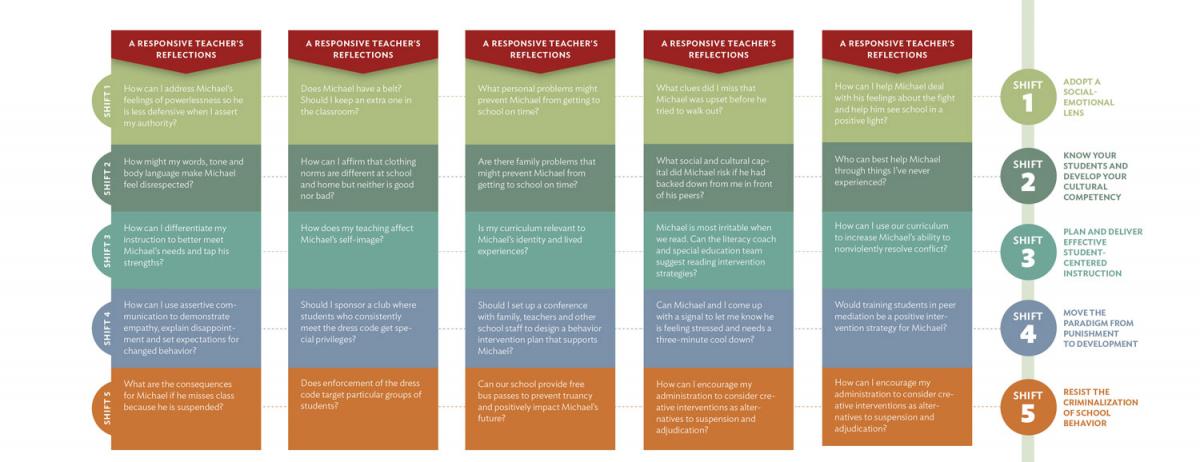
Click to enlarge
TYPE OF BEHAVIOR:Verbal Disrespect
Michael is defiant and uses inappropriate language when verbally redirected.
A PUNITIVE TEACHER’S REACTIONS: Argue with Michael, kick him out of class or refer him for disciplinary action.
TYPE OF BEHAVIOR: Dress Code Violation
Michael comes to class without a belt on, pants sagging.
A PUNITIVE TEACHER’S REACTIONS: Lecture Michael about the dress code in front of classmates, kick him out of class or refer him for disciplinary action.
TYPE OF BEHAVIOR: Lateness or Truancy
Michael is frequently absent from or tardy to his first-period class and is failing.
A PUNITIVE TEACHER’S REACTIONS: Lock the door after the bell rings and give Michael zeros with no make-up option for work he missed.
TYPE OF BEHAVIOR: Aggressive Physical Behavior
Michael shouldered his teacher out of the way when she blocked the classroom door as he tried to leave.
A PUNITIVE TEACHER’S REACTIONS
Argue with Michael, call the school resource officer, bar him from class or press assault charges.
TYPE OF BEHAVIOR: Fighting
Michael got into a fight in the hallway during first period. There were no serious injuries.
A PUNITIVE TEACHER’S REACTIONS: Avoid involvement or request that Michael not be allowed back in class because he poses a threat.
>> Toolkit: Learn how teachers can shift their behaviors and help reduce student push-out.
>> View the PDF version of this article
Comments
Post a Comment